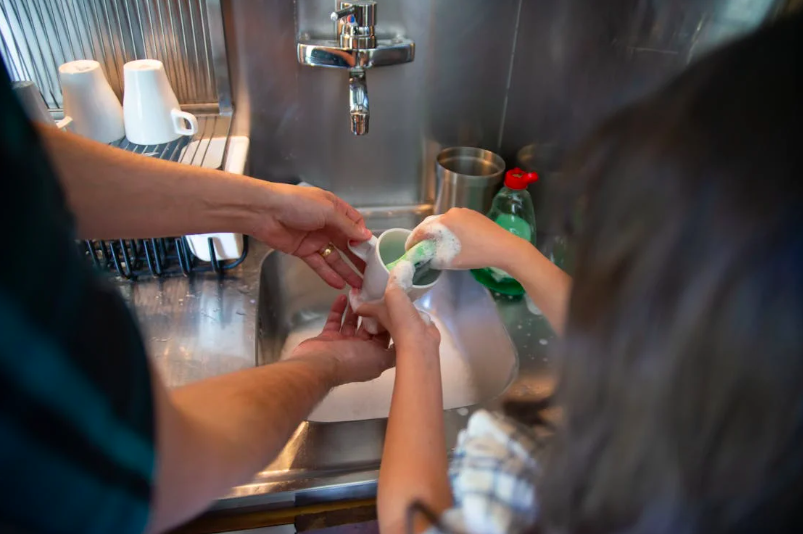
There is a couple on the internet folding laundry together. Slowly. Intentionally. There is soft music playing in the background and warm lighting that makes the entire apartment look expensive in a way that feels impossible if you have ever actually lived with another person. The caption says this is romance now. Or rather, this is what romance should have been all along.
The word for it is “choremance,” which is exactly the kind of term that could only exist online first and in real life later. It describes couples turning domestic labour into intimacy: grocery shopping together on Sundays, assembling IKEA furniture without fighting, one person washing dishes while the other wipes down the counters. The internet has decided that this is the new love language, and maybe that makes sense. Grand romantic gestures feel slightly embarrassing now. Nobody wants to admit they still want to be adored in huge, unreasonable ways. So we have replaced fantasy with practicality and called the trade emotionally mature.

But I keep thinking about how strange it is that we are framing the basic logistics of survival as aspiration. As if splitting household tasks evenly is not the minimum requirement of living with another person but evidence of emotional transcendence.
“Strip away the cultural wrapping and what choremance actually describes is two exhausted adults dividing the work of staying alive.”
The question worth sitting with is not whether shared chores can carry meaning. They can. A partner who takes a task off your plate without being asked is doing something genuinely valuable, and only a fool would argue otherwise. The question is whether we have started mistaking the absence of friction for the presence of connection.
There is a difference. A rather important one.
Most modern relationships are operating under conditions earlier generations would have classified as a crisis. Two careers. Long commutes. Devices that extend the workday into the bedroom and then politely apologise for it. Children, if there are any, raised on schedules that resemble logistics more than childhood. Inside this, the romantic gesture — the deliberate, slightly inconvenient, slightly extravagant act of showing up for another person — has become genuinely difficult to sustain.
So we have done what professionals always do when faced with constraint. We have optimised.
We optimised our calendars, our diets, our sleep, our morning routines, our breathwork, our gut microbiomes. It was only a matter of time before the logic arrived at the bedroom door, took its shoes off, and asked where it could plug in. And here we are: efficiency dressed up as romance, divided labour rebranded as devotion, a synced Google Calendar treated as a love language.
“The boardroom mindset has finally arrived at the bedroom, and it has brought a synced Google Calendar with it.”

The trouble is that intimacy is not a productivity problem. It does not respond to the tools that solve productivity problems. You cannot batch-process closeness. You cannot automate emotional attention. There is no app for being known, though I am sure three are in beta. The things that make a relationship feel alive — being seen, being chosen, being met without an agenda — require a kind of inefficient presence that resists optimisation by design. Which is to say, it cannot be made shorter, easier, or better leveraged. It can only be done.
“You cannot batch-process closeness. You cannot automate emotional attention. There is no app for being known, though I am sure three are in beta.”
Choremance is not the villain here. The villain is the quiet exhaustion that makes choremance feel like enough.
Look closely and a pattern emerges. Choremance belongs to a wider cultural reflex: taking the conditions of survival and selling them back to us as lifestyle, ideally with a long-form Instagram caption attached. Burnout becomes “soft life.” Cancelled plans become “self-care.” Sleeping in becomes “rest as resistance.” Eating cereal for dinner becomes “intuitive nutrition.” The minimum we are capable of, on the worst days we are having, gets reframed as a deliberate, almost subversive choice. Marketing has solved a problem nobody asked it to solve.
“We have taken the conditions of survival and sold them back to ourselves as lifestyle, ideally with a long-form Instagram caption attached.”
It is comforting language. It is also a very polite way of avoiding a harder conversation about what we are no longer giving each other.

There is a real distinction between intentional intimacy and skilled coexistence, and it is worth naming because almost no one is. Coexistence is logistical. It asks: are we managing the household? Are we splitting the load? Are we being fair? These are decent questions. Required ones, even. But they are not the same questions as: do you still see me? Do I still surprise you? Are we more than two people running the same small organisation, and would HR notice if we left?
A relationship can be operationally excellent and quietly empty. It happens more than anyone admits. It is one of the more common forms of unhappiness in long marriages, and almost no one talks about it because there is nothing dramatic to point at. No fight. No betrayal. No third person. Just a slow drift into roommate, with shared expenses and a Netflix profile each.
“A relationship can be operationally excellent and quietly empty. No fight. No betrayal. Just a slow drift into roommate.”
This is the risk choremance carries when we mistake it for the whole of love rather than a useful slice of it.
I am not arguing for grand gestures. The candlelit-dinner industry has done quite enough damage on its own, and frankly, surprise weekend getaways are how affairs begin in films. What I am arguing for is the recovery of a category we seem to be losing: the deliberate act, made for no operational reason, that exists only to communicate that the other person matters beyond their function in the household.
That category is hard to defend in a culture that worships efficiency. It looks indulgent. It feels inefficient. It is.
That is rather the point.
If choremance is what we have left, fine. We will live, and the laundry will get folded. But it is worth being honest about what it is — a workable arrangement under difficult conditions — rather than dressing it up as a revolution. Love did not need to be redefined. It needed to be defended. There is a difference between the two, and the language we use will decide whether we still know which one we are doing.