By the time a wellness trend reaches your feed for the third or fourth time, a soft-lit video, a creator lying supine with a gauze square taped over their navel, it has already crossed the invisible threshold from fringe ritual to mainstream curiosity. The latest to make that leap is the ‘castor oil belly patch’, a homespun remedy repackaged for the algorithm age.
On platforms like TikTok and Instagram, influencers promise that a few drops of warmed castor oil, massaged into the belly button and sealed with a patch, can do everything from easing bloating to detoxing the liver. Some claim it helps with weight loss, hormonal balance and even sleep.
It is, in other words, a cure-all, which is precisely what makes doctors wary.
What is the trend all about?
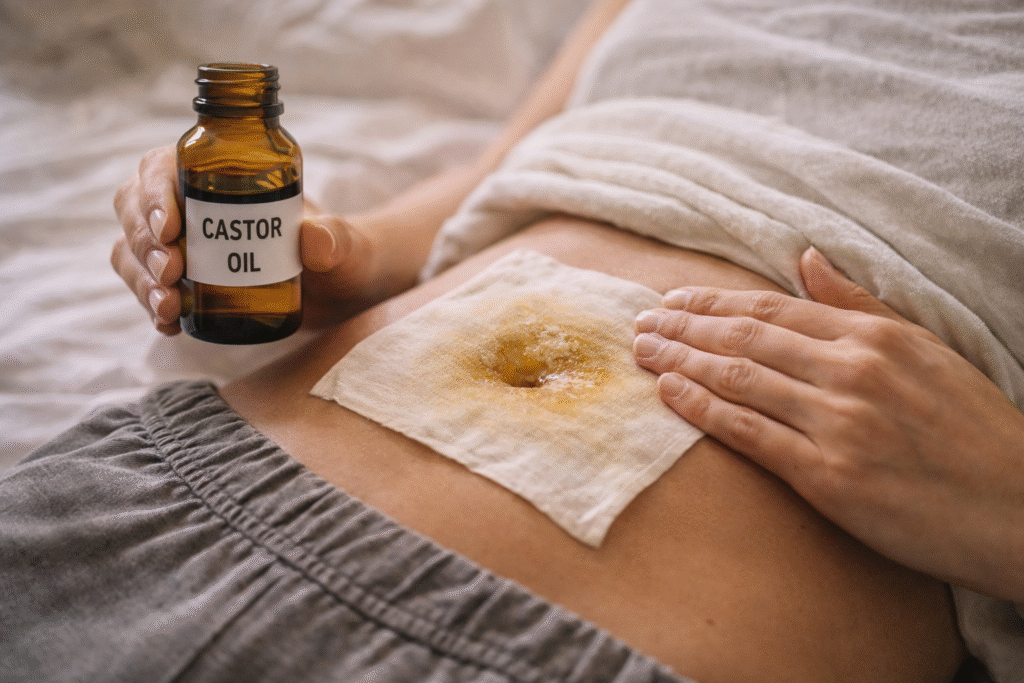
Castor oil itself is hardly new. Derived from the seeds of the Ricinus communis plant, it has been used for centuries in beauty routines and, more definitively, as a stimulant laxative when taken orally. The practice of applying oil around the navel, sometimes referred to as ‘navel pulling’, draws loosely from Ayurvedic traditions, lending the trend a sense of inherited wisdom.
But as Dr Vaibhav Gupta, a senior consultant in internal medicine at Regency Health in Kanpur, explains, what’s circulating online is less tradition than reinterpretation. “The ritual has been adapted into a simplified, aesthetic-friendly format,” he says, one that fits neatly into the language of contemporary wellness: detox, glow, reset.
Is there any scientific evidence to back it?
The central claim that castor oil can be absorbed through the belly button and influence internal organs collapses under scrutiny.
“There is no scientific evidence to support this mechanism,” says Dr Hari Kishan Boorugu, a consultant physician and infectious disease specialist, Yashoda Hospitals, Hyderabad. “The idea that the oil gets absorbed through the skin in a way that meaningfully affects digestion is not backed by medical research.”
One persistent myth cited in online videos is the existence of a so-called ‘Pechoti gland’, an anatomical gateway beneath the navel that supposedly facilitates absorption. In reality, Dr Gupta notes, the belly button is simply scar tissue and a remnant of the umbilical cord, not a portal.
The only well-established benefits of castor oil remain straightforward: it can act as a laxative when ingested and as a moisturiser when applied to the skin. Anything beyond that exists in the realm of anecdote.
Why it feels like it works
And yet, many users swear by it.
Part of the explanation lies not in the oil itself, but in the ritual surrounding it. Massaging the abdomen in a clockwise motion can stimulate the natural movement of the colon, potentially easing mild bloating. The warmth of a compress may soothe discomfort. And the act of lying still, of carving out a pocket of rest in an overstimulated day that has its own quiet therapeutic value.
“These benefits are modest,” Dr Gupta says, “and they come from the massage and warmth, not from the oil being absorbed into the body.”
Why is it gaining popularity on social media?
The trend’s rapid spread owes much to the mechanics of social media. A quick search yields thousands of videos, many with identical framing and reassuring testimonials. The effect is cumulative: repetition breeds credibility.
“There’s a strong bandwagon effect,” Dr Gupta says. “When people see others claiming relief, it becomes persuasive.”
The appeal is also psychological. The method is simple, inexpensive and natural.
Does it have any risks?
For most people, the patches are unlikely to cause serious harm. But that does not make them entirely benign.
Prolonged use, especially overnight, can lead to skin irritation, clogged pores or acne. Those with sensitive skin or conditions like eczema may be more vulnerable.
More concerning, doctors say, is the risk of substitution. “People may delay seeking proper medical care,” Dr Boorugu warns, relying instead on an unproven remedy for persistent gastrointestinal issues.
The broader claims circulating online that castor oil can dissolve fat or cleanse the liver are unequivocally false. The body’s detoxification systems are governed by the liver and kidneys, not topical oils.
A familiar pattern
If the castor oil patch feels familiar, it is because it follows a well-worn trajectory. A traditional practice is rediscovered, reframed through the lens of modern wellness, amplified by social media, and stripped of nuance along the way.
What remains is something both comforting and misleading: a ritual that feels meaningful, even when its promised effects do not hold up.
For those tempted to try it, doctors suggest approaching it as a relaxation practice rather than a medical treatment — a way to unwind, perhaps, but not to heal.
Also Read:
Why Doctors Are Paying Closer Attention to Insulin Resistance
Can What You Eat Be Ageing Your Skin Faster?
7 Morning Rituals from Around the World